


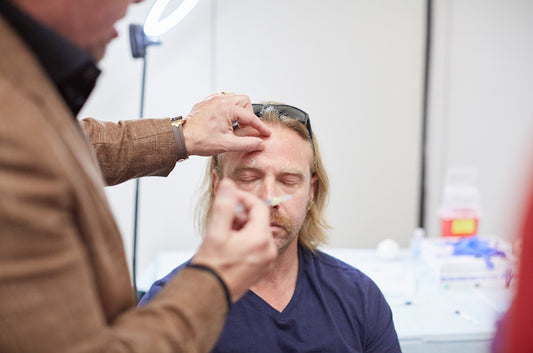


Introduction
The under-eye area, also known as the tear trough, is one of the most delicate and technically challenging regions of the face to treat. Even minor volume loss here can create dark shadows, hollows, and a fatigued appearance. Hyaluronic acid (HA) fillers offer a non-surgical way to restore smoothness and brightness — but they require anatomical precision and aesthetic restraint.
In this guide, we’ll break down how under-eye fillers work, what results patients can expect, and how proper technique ensures safety and longevity. For comprehensive tear trough anatomy and injection training, providers can access video-based modules inside Empire On-Demand.
Understanding Under Eye Anatomy
Snippet: Safe, natural filler outcomes start with mastery of periorbital anatomy.
The tear trough lies along the orbital rim, bordered by the orbicularis oculi muscle and thin skin overlaying the infraorbital fat pads. With age, fat and collagen loss deepen the groove, creating shadowing. Fillers replace lost volume, but improper placement can lead to swelling, visible lumps, or blue discoloration (Tyndall effect).
The ideal candidate has mild-to-moderate hollowness without significant skin laxity or puffiness. Patients with fluid retention, festoons, or severe crepiness are better treated with energy-based tightening or platelet-rich plasma before filler placement.
What to Expect Before Treatment
Consultation and Assessment
A detailed consultation determines candidacy, filler type, and risk factors such as allergies, thyroid issues, or previous filler use. The practitioner evaluates:
-
Skin thickness and elasticity
-
Degree of hollowing vs. puffiness
-
Vascular anatomy under the eyes
-
Facial symmetry and adjacent cheek support
Preparation
Patients are advised to avoid alcohol, NSAIDs, and supplements that increase bruising (vitamin E, fish oil) for 48 hours prior. Makeup is removed, and topical anesthetic may be applied. Photography is taken to document baseline and for comparison in “before and after” visuals.
For mastery of patient assessment, injection vector mapping, and filler rheology, practitioners can enroll in Comprehensive Dermal Filler Training — Level I.
The Procedure
Snippet: A delicate, precise technique ensures smooth blending and minimal risk.
Most injectors use a microcannula to reduce bruising and avoid vascular injury. The filler is deposited in small threads along the periosteum or within the deep tear trough compartment. Overcorrection is avoided — subtle volume yields the most natural “after” results.
Procedures typically take 15–30 minutes. Mild swelling or bruising resolves within several days. Patients can resume normal activities the next day, avoiding vigorous exercise and massage for 48 hours.
Expected Results: Before and After
Before:
-
Deep hollows beneath the eyes
-
Shadowing that makes patients look tired
-
Uneven transition between lower eyelid and cheek
After:
-
Smoother, brighter under-eye contour
-
Reduced shadowing and dark circles
-
Improved facial harmony and refreshed expression
Results are visible immediately, with full integration after 1–2 weeks. Depending on the product and patient metabolism, effects last 9–18 months.
Providers mastering natural under-eye filler blending and correction can benefit from advanced cadaver-based anatomy insights in Advanced Facial Anatomy Cadaver Workshop for Aesthetics.
Safety and Potential Complications
Bruising and Swelling
Minor and temporary; ice and arnica can help.
Tyndall Effect
A blue hue can appear if filler is placed too superficially. Dissolve with hyaluronidase if needed.
Edema or Puffiness
Occurs if excessive filler attracts water. Use soft, low-hydrophilic gels and conservative volumes.
Vascular Occlusion (Rare)
An emergency requiring prompt recognition and treatment with hyaluronidase and massage. Early education in occlusion management is critical to patient safety.
For protocol-based management of filler complications, including vascular events, visit Complications Mastery Program.
Aftercare Instructions
-
Avoid touching or massaging the area for 24 hours.
-
Sleep elevated the first night to minimize swelling.
-
Refrain from alcohol and intense exercise for 24–48 hours.
-
Apply cold compresses intermittently on the day of treatment.
-
Use gentle, hydrating eye creams with peptides or hyaluronic acid.
Realistic Expectations
Under-eye filler is transformative but subtle. The goal is refinement, not reinvention. Patients should understand that fillers cannot treat dark pigmentation, crepey skin, or puffiness caused by fat herniation. Those issues may require resurfacing or surgical blepharoplasty. Setting expectations clearly ensures satisfaction and trust.
Clinical Takeaway
When performed with precision, under-eye filler is one of the most rewarding non-surgical procedures in aesthetic medicine. Proper assessment, anatomy knowledge, and conservative dosing produce natural “before and after” transformations that restore brightness without altering facial character.
For safe, predictable outcomes, combine sound injection technique with advanced education through Empire On-Demand’s comprehensive filler and anatomy training programs.
FAQs
-
How long do under-eye fillers last?
Typically 9–18 months depending on product, metabolism, and placement depth. -
Is the procedure painful?
Most patients feel minimal discomfort with topical anesthetic and cannula use. -
What is the recovery time?
Mild swelling or bruising can last 2–5 days; makeup may be applied after 24 hours. -
Can filler fix dark circles?
It improves shadowing from hollows but not pigment; skincare or laser may be needed. -
Can under-eye filler migrate?
Migration is rare when injected in the correct plane and amount. -
How much filler is usually used?
Usually 0.3–0.6 mL per side; less is more for this region. -
When should results be reviewed?
Schedule follow-up at 2 weeks for integration and symmetry assessment. -
Who is not a candidate?
Patients with festoons, chronic swelling, or prior filler complications should avoid it. -
Can filler be reversed?
Yes, hyaluronic acid fillers can be dissolved safely with hyaluronidase. -
Are results immediate?
Yes, though minor swelling may obscure final results for a few days.
References
-
Beleznay K, et al. “Vascular Compromise from Soft Tissue Filler Injection.” Plast Reconstr Surg. 2019.
-
Gold M, et al. “Hyaluronic Acid Fillers in the Tear Trough: Safety and Efficacy.” Dermatol Surg. 2023.
-
Funt D, Pavicic T. “Anatomy of the Tear Trough and Safe Injection Techniques.” Aesthet Surg J. 2021.
-
Carruthers J, et al. “Patient Satisfaction After Under-Eye Rejuvenation with HA Fillers.” J Cosmet Dermatol. 2022.
-
DeLorenzi C. “Complications of Injectable Fillers: Management and Prevention.” Aesthet Surg J. 2020.


